Sebastian Vettel
Sebastian Vettel (German pronunciation: [zeˈbasti̯an ˈfɛtəl]; born 3 July 1987) is a German Formula One racing driver, currently driving for Red Bull Racing. He is the current World Champion, having won in the 2010 season.

In his first year driving for Red Bull in 2009,
Vettel finished the season as the youngest-ever championship runner-up.
He also secured Red Bull's first pole position and race win in the
team's history. The following year he went on to become the youngest
driver ever to win the World Drivers' Championship. In the same year he
helped Red Bull win the team's first World Constructors' Championship, along with teammate Mark Webber.
Vettel is also the youngest Formula One driver to drive at a Grand
Prix meeting, at 19 years and 53 days, to score championship points (on
his race debut at the 2007 United States Grand Prix), to lead a race (at the 2007 Japanese Grand Prix), to secure pole position and to win a race2008 Italian Grand Prix). (both for the
Early and personal life
Vettel was born in Heppenheim,
West Germany. He has one younger brother, Fabian, and two older
sisters, Melanie and Stefanie. Vettel suggested in an interview that he
was terrible at school, but actually earned his Abitur (high school
diploma) with a respectable GPA. He also mentioned that his childhood heroes were "The three Michaels", who were Michael Schumacher, Michael Jackson and Michael Jordan. He stated that he wanted to be a singer like Michael Jackson but realised that he could not as he did not have the voice. Vettel lives in Switzerland amongst other racing drivers and is a fan of German football team Eintracht Frankfurt.

Career
Junior series
Vettel started racing karts in 1995, winning various titles such as the Junior Monaco Kart Cup in 2001. In 2003, he upgraded to open-wheel cars and won the 2004 German Formula BMW Championship with 18 victories from 20 races. In 2005 he drove for ASL Mucke Motorsport in the Formula Three Euroseries. He was placed fifth in the final standings with 64 points, winning the year's top rookie honours. He tested the Williams FW27 Formula One car on 27 September as a reward for this Formula BMW success. He then went on to test for the BMW Sauber team.
Vettel finished as runner-up in the 2006 F3 Euroseries, behind series leader and team mate Paul di Resta. He also made his debut in the World Series by Renault at Misano, winning after Pastor Maldonado was disqualified. However, at the next round at Spa-Francorchamps, his finger was almost sliced off by flying débris in an accident, and he was expected to be out of racing for several weeks. Nevertheless, he managed to compete in the Ultimate Masters of F3 at Zandvoort
the following weekend, finishing in sixth place. He also set the
third-fastest lap time, and it surprised his ASM team boss Frédéric
Vasseur. Vasseur said: "I was impressed for sure, because at the
beginning of the week I was sure he wouldn't race! But he showed good
pace from the first practice session. I can't imagine he's 100 per cent
but at least we know we can be competitive in the next F3 Euroseries
round at the Nürburgring next weekend – that's important."
Vettel competed in the World Series by Renault in 2007, and took his first win at the Nürburgring. He was leading the championship when he was called up to Formula One permanently. His seat was taken by Michael Ammermüller.
Formula One
2006–2007: BMW Sauber
2006
Vettel became BMW Sauber third driver at the 2006 Turkish Grand Prix, when former incumbent Robert Kubica was called up to replace Jacques Villeneuve for the 2006 Hungarian Grand Prix.
On his testing debut, Vettel set the fastest time in the second Friday Free Practice before the race. In his second testing session in the 2006 Italian Grand Prix,
he set the fastest time in both Friday practice sessions, a race
weekend in which all the BMW cars were quick, with his predecessor
Robert Kubica finishing on the podium in the race.
2007
Vettel was confirmed as BMW's test driver for 2007. Following the serious crash of regular BMW driver Kubica at the Canadian Grand Prix, Vettel substituted for him at the United States Grand Prix.
Vettel was pulled mid-season from the Formula Renault series, which he
was leading at that time. He started in seventh position on the grid,
finishing in eighth position to take his first World Championship point
and became the youngest driver ever to score a point in Formula One (at
the age of 19 years and 349 days), a record previously held by Jenson Button – who was 20 years and 67 days old when he finished sixth at the 2000 Brazilian Grand Prix.
2007–2008: Toro Rosso
2007
On 31 July 2007, BMW released Vettel to join Red Bull's Scuderia Toro Rosso team, replacing Scott Speed as one of its drivers from the Hungarian Grand Prix onwards. He earned approximately US$165,000 for finishing the season with Toro Rosso. Before the race, it was also announced that Vettel would drive for Toro Rosso in 2008, partnering Sébastien Bourdais.
Vettel struggled for his first couple of races while cutting his
teeth with his new team, but managed two impressive drives in his 5th
and 6th drives for Toro Rosso, a team that was averaging a little worse
than 14th place in the 2007 season before Vettel's arrival. In the
rain-hit Japanese Grand Prix at Fuji, Vettel worked his way up to third, behind Lewis Hamilton and Red Bull Racing's Mark Webber,
and seemed to be on course for not only his but also Toro Rosso's
maiden podium finish. However, Vettel crashed into Webber under safety
car conditions taking them both out of the race and prompting Webber to
say to ITV reporter Louise Goodman
"It's kids isn't it... kids with not enough experience – they do a good
job and then they fuck it all up." Webber also specifically criticized
Lewis Hamilton's erratic behaviour in contributing to the accident,
describing his antics behind the safety car as 'shit'."[17][18]
Vettel was initially punished with a ten-place grid penalty for the
following race, but this was lifted after a spectator video on YouTube showed the incident may have been caused by Hamilton's behaviour behind the safety car. Vettel bounced back to finish a career-best fourth a week later at the Chinese Grand Prix
having started 17th on the grid while in mixed conditions. He collected
five championship points, making it both his and Toro Rosso's best race
result.
Red Bull owner Dietrich Mateschitz
stated his belief Vettel would be one of Formula One's big stars in the
future. "Vettel is one of the young guys with extraordinary potential
[...] He is fast, he is intelligent, and he is very interested in the
technical side."
2008
After four races of the 2008 season, Vettel was the only driver to
have failed to finish a single race, having retired on the first lap in
three of them. In each of these three instances, he was involved in
accidents caused by other drivers, the other being an engine failure.
However, at the fifth round at the Turkish Grand Prix,
he finally saw the chequered flag, albeit finishing in 17th after
qualifying 14th and suffering a puncture on the opening lap. In the next
race at the Monaco Grand Prix, Vettel scored his first points of the season with a fifth place finish, after qualifing 17th. He scored again at the Canadian Grand Prix
fighting off Heikki Kovalainen in the last few laps for the final
championship point, having started from pit lane. Vettel finished 12th
in France, before retiring on lap one at the wet British Grand Prix after being clipped by David Coulthard and aquaplaned into the gravel trap along with Coulthard. He earned another point at the German Grand Prix, fending off Fernando Alonso and securing eighth after Jarno Trulli ran wide. Vettel retired in Hungary after his engine overheated during his first pit stop. He impressed many at the European Grand Prix
by setting the fastest times in the first practice session and second
qualifying session, before qualifying sixth on the grid. Vettel finished
the race in sixth, two seconds behind Jarno Trulli.
At the 2008 Italian Grand Prix, Vettel became the youngest driver in history to win a Formula One Grand Prix. Aged 21 years and 74 days, Vettel broke the record set by Fernando Alonso at the 2003 Hungarian Grand Prix by 317 days as he won in wet conditions at Monza.
Vettel led for the majority of the Grand Prix and crossed the finish
line 12.5 seconds ahead of McLaren's Heikki Kovalainen. It was the first
podium and win for his Toro Rosso team. Earlier in the weekend, he had already become the youngest polesitter, after setting the fastest times in both Q2 and Q3 qualifying stages, and his win also gave him the record of youngest podium-finisher. Toro Rosso team boss Gerhard Berger said, "As he proved today, he can win races, but he's going to win world championships. He's a cool guy". Hamilton praised the German, stating that this victory showed "how good he is". The nature of the victory and the story of the 21 year old's fledgling career led the German media to dub him "baby Schumi",
although Vettel was quick to downplay the expectation the result has
brought, particularly the comparison with the seven-time World Champion:
"To compare me with Michael Schumacher is just a bit ridiculous...It
will be difficult in normal conditions for us to repeat this
achievement". He then went on to finish fifth in Singapore. In Japan, he finished sixth after being promoted from seventh after team-mate Bourdais was penalised for contact with Felipe Massa.
In the Brazilian Grand Prix,
after running second for much of the race on a one-stop strategy,
Vettel overtook Lewis Hamilton in the rain for fifth place on the
penultimate lap to contribute to a thrilling climax to the season. He
nearly deprived the McLaren driver of the championship before Timo Glock
slowed dramatically on the last lap (he was struggling with dry tyres
in the ever increasing rain) enabling both Vettel and Hamilton to pass
him, earning Hamilton the title, and Vettel fourth place.
After the season had finished Vettel was named Autosport Rookie of the Year.
Red Bull Racing
2009
At the start of the 2009 season, Vettel replaced the retired David Coulthard at Red Bull Racing, and began strongly at the Australian Grand Prix, qualifying third and running in second for the majority of the race. However, a clash with Robert Kubica
over second place on the third to last lap of the race forced both to
retire. Vettel attempted to finish the race on three wheels behind the
safety car to salvage some points, but eventually pulled off to the
side. He thought that he would be able to attempt this because the
yellow flag resulting from his incident forbids overtaking; instead he
was given a ten-place grid penalty for the next race, the Malaysian Grand Prix, and his team was fined for instructing him to stay on track after the damage occurred.
In Malaysia he qualified in third position, but was demoted down to
13th due to his ten-place grid drop. He spun out of the race while
eighth, just before the race was stopped due to adverse weather
conditions. However in China he went on to take pole position, the first for the Red Bull Racing team. He went on to win the race ahead of team-mate Mark Webber, again a first for his team, which scored its first victory and one-two finish in the same race.
At the age of 21 years and 287 days, Vettel became the youngest Grand
Prix driver in history to win for two different teams, having won the 2008 Italian Grand Prix for the Torro Rosso-team.
In the Bahrain Grand Prix, Vettel qualified in third, and finished second behind Jenson Button in the race. In Spain, he qualified in second but finished the race in fourth, behind his team-mate Mark Webber who finished in third. Vettel won the British Grand Prix after claiming pole position in qualifying. At the German Grand Prix he qualified fourth and finished second, behind Webber, who won his first Grand Prix.Hungarian Grand Prix,
Vettel qualified second after an eventful qualifying, but had to retire
from the race on lap 30 after his car sustained damage from contact
with Kimi Räikkönen's car on the first lap. At the
At the European Grand Prix,
he qualified fourth but had to retire from the race with an engine
failure. It was the second engine failure for Vettel during the weekend,
and the RB5's reliability issues began to show. He finished third at Spa-Francorchamps,
and struggled for pace at Monza, finishing 8th at a race he previously
won. He qualified 2nd at Singapore, but was given a drive-though penalty
for speeding in the pit lane and damaged the diffuser on a kerb,
struggling to 4th. He subsequently won the Japanese Grand Prix from pole position.
At the Brazilian Grand Prix, Vettel qualified 16th in a rain-hit session, behind title rival Jenson Button (14th) and Rubens Barrichello (1st), while his team-mate Webber qualified second with Adrian Sutil
in third. Vettel needed to score at least second place in the race to
keep his title hopes alive. He finished fourth with Button behind,
giving Button the Championship and moving Vettel up into second place.
He officially claimed second place by winning the inaugural Abu Dhabi Grand Prix, again ahead of Webber with Button completing the podium. He also scored his third fastest lap of the year, drawing him level with team-mate Webber. However, as Vettel had more second fastest laps, he won the 2009 DHL Fastest Lap Award.
2010
Vettel continued with Red Bull for 2010, and took the first pole position of the season at the Bahrain Grand Prix.
Vettel went on to lead most of the race but a spark-plug failure meant
that his lap times slowed down, and as a result the two Ferraris and the
McLaren of Lewis Hamilton passed him. After a brief challenge from
Rosberg he brought the car home in fourth.
At the Australian Grand Prix, Vettel was appointed as a director of the Grand Prix Drivers' Association. He took his second consecutive pole position in Australia, ahead of team-mate Mark Webber, but spun off when leading the race, due to a loose wheel nut. In Malaysia, he took his first win of the 2010 season with Webber coming in second place, having passed both him and Nico Rosberg at turn one.
Vettel qualified on pole at China alongside Webber. At the start of the wet race Fernando Alonso jump-started
and Vettel was passed by Webber, dropping back to third. The increasing
rain forced Vettel and Webber to pit at the same time for intermediate
tyres that wore out after only a few laps and dropped them back into the
midfield. Vettel slowly climbed back up to finish sixth, ahead of
Webber. In Spain,
Vettel was outqualified by team-mate Webber and claimed second on the
grid. Despite having a major brake problem during the last eight laps,
Vettel managed third place after Hamilton crashed on the penultimate
lap.
In Monaco
Vettel was again outqualified by Webber. In the race he passed Kubica
at the start and stayed there for the remainder of the Grand Prix and
made it a Red Bull 1–2. After the race the two Red Bull drivers were
equal on points in the drivers' championship, with Webber championship
leader based on total wins. At the Turkish Grand Prix
he qualified third and was running second behind Webber when he made a
passing move on the Australian. Vettel lost control of his car and the
two collided, putting Vettel out of the race and dropping him to fifth
in the drivers' championship, with neither driver accepting
responsibility for causing the collision. He finished fourth at the Canadian Grand Prix, maintaining his position in the standings. He started the European Grand Prix in pole position and led from start to finish to score his second win of the season.
At Silverstone,
both Vettel and Webber's cars were fitted with a new design of front
wing. Vettel's front wing was damaged in the third practice session, and
Webber's sole surviving example was removed and given to Vettel.
Vettel qualified in pole position ahead of his team-mate, but suffered a
puncture caused by driving wide off the track on the first lap of the
race and fell to the tail of the field. He fought back to finish seventh
while Webber took the victory. At the German Grand Prix he took pole by 0.002 seconds, and finished in third position in the race, behind the Ferraris of Alonso and Felipe Massa, after a poor start. He also finished third in Hungary
after serving a drive-through penalty for exceeding ten lengths behind
the previous car, team-mate Webber, under neutralised safety car
conditions. In Belgium,
he had a tough race, hitting Button's car whilst attempting to pass,
causing Button to retire. Vettel pitted and carried on, but then
suffered a puncture whilst passing Liuzzi at the same place, completing a
whole lap with a puncture. He eventually finished 15th, which was
(other than his retirements in Australia and Turkey) was his worst
finish of the season. At Monza he finished fourth after an engine problem scare, and at the Singapore Grand Prix,
Vettel qualified and finished second, sticking on Alonso's tail for
most of the race. He passed Button for fourth place in the championship.
At the Japanese Grand Prix,
he dominated all practice sessions bar one, as it was postponed after
heavy rain. He qualified on pole ahead of team mate Webber and went on
to win with a lights-to-flag victory. Aged 23 years and 98 days, Vettel
became the youngest Grand Prix driver to win at the same track on two
occasions, having also won the Japanese Grand Prix at Suzuka in 2009. At
the first Korean Grand Prix, Vettel took pole and led the first 45 laps of the race before retiring with engine failure, handing victory to Alonso.
At the Brazilian Grand Prix,
Vettel qualified second but took the lead at the first corner and led
for the entire race to victory. With Webber taking second place, and
Alonso finishing third, Vettel went into the final race of the season
with a 15-point deficit to Alonso, and a 7-point gap to Webber. With the
one-two finish in Brazil, Vettel and Webber secured Red Bull Racing's
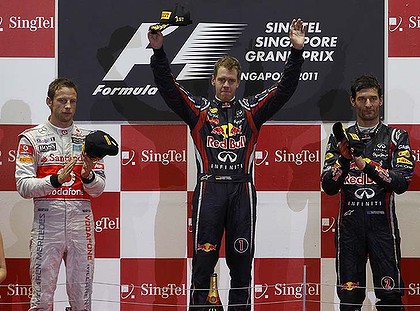
first Formula One World Constructors' Championship. He won the Abu Dhabi Grand Prix from pole again, to take the drivers' championship lead for the first time in his career and became the youngest world champion in the sport's history. Following James Hunt in the 1976 season,
this was also only the second time in Formula One history when the
World Champion had not been championship leader at any earlier point in
the season.
2011
After the postponement of the Bahrain Grand Prix, Vettel started his title defence in style in the Australian Grand Prix with pole position and a victory of 22 seconds over title rival Lewis Hamilton, who was nursing home his broken McLaren. Vettel continued his title defence in the Malaysian Grand Prix, where he claimed pole position and went on to win the race. Vettel completed his third pole position of the season at the Chinese Grand Prix,
and appeared to be in dominating form for the majority of the race.
However, poor tyre management haunted him in the last several laps,
possibly being related to him being unable to properly communicate with
his team as his radio was broken. He finished the race second, his
championship lead cut to 21 points, by Hamilton, after three races.
The Turkish Grand Prix
started out poorly for Vettel, where he had very little practice time
during the Friday free practice sessions, including a crash in the first
session. Even with the limited practice, he claimed his fifth
consecutive pole position and converted it into a win, extending his
championship lead over Hamilton to 34 points. At the Spanish Grand Prix, his pole position streak ended as his KERS
failed him during qualifying. His teammate Webber took pole, but Vettel
went on to win the race by 0.6 seconds over Hamilton, despite having to
deal with a frequently malfunctioning KERS. The following weekend, in the Monaco Grand Prix,
he took pole with the second fastest qualifying time in Monaco's
history. Vettel was leading the race with a 5 second gap to second
placed Button. Due to a radio malfunction the Red Bull pit crew was not
prepared for Vettel when he pitted. The net result was that the pitstop
was slow, and that he was sent out on the wrong tyres, handing the lead
to Button as well. Vettel switched to a one-stop strategy, and stuck
with one set of soft tyres for 56 laps. He was caught by Alonso and
Button as his tyres deteriorated, but neither were able to pass him.
With a few laps remaining, the race was red-flagged after Vitaly Petrov
required an ambulance after an accident. The suspended race allowed
teams to change tyres and work on the cars, and when the race was
restarted under the safety car, Vettel was able to retain the lead
during the last few laps.
Vettel won the Monaco Grand Prix, for his fifth win from the first six races and was his first win in the principality.
In Canada, he took his sixth pole position in seven races ahead of Fernando Alonso and Felipe Massa.
Vettel kept his lead from the start of the race, and for the vast
majority of the race he held on to it. The record six safety car periods
due to the down-pouring rain and 2 hour race suspension profoundly hurt
Vettel's chances of victory, however, as after every safety car restart
Vettel would lose the gap he had previously built up on the other
drivers. With much fresher tyres, Button caught Vettel and began to
pressure him in the last lap. Vettel slid on a damp part of the track at
Turn 6, and Button used the opportunity to slip past him to take the
victory. Vettel finished second, extending his championship lead to 60
points ahead of Button.
At the European Grand Prix, the FIA
began enforcing a controversial ban on engine mappings. It was believed
by many in the press that it was an attempt by the FIA to thwart
Vettel's domination of the season.
The changes appeared to do little to hinder Vettel, as he took pole
with the fastest qualifying lap in the track's history. He dominated the
race with his first triple of 2011 with pole, fastest lap, and won his
sixth race out of eight races. It was the first time in Formula One
history where, in the first eight races, a driver finished first in six
or more races and second or better in the remaining races.
The second set of controversial mid-season changes were implemented at Silverstone, targeting the blown diffusers. Red Bull believed the changes cost them about half a second per lap.
Webber just edged Vettel for pole position by 0.032 seconds in
qualifying. On race day, Vettel made a better start, immediately took
the lead and led the first half of the race. A delay at one of his pit
stops gave the race lead to Alonso, who passed him in the pit lane, and
dropped Vettel back to third, behind Hamilton. Despite a malfunctioning
KERS unit, he was able to jump Hamilton in the stops and held off the
faster Webber, who ignored a radio message from team principal Christian Horner to hold position, for second place, extending his lead in the championship.
Vettel's run of fourteen successive front-row starts and eleven successive top two finishes ended at his home race, where he qualified third and finished fourth. McLaren's mechanical grip outclassed Red Bull in the wet in Hungary,
and despite leading into the first corner from pole, he was quickly
passed by both Hamilton and Button. Vettel eventually finished second in
the race, held in mixed conditions. In Belgium,
Vettel qualified on pole and won the race, his seventh victory of the
season and seventeenth of his career. In victory, Vettel extended his
lead in the championship to 92 points and, even with seven races left,
his tally of 259 points surpassed his own record, from 2010 for the highest number of championship points accumulated in a season. At the Italian Grand Prix at Monza, he took his tenth pole position of the year – joining Ayrton Senna as the only drivers to have taken ten pole positions in two separate seasons – and the 25th of his career,
and eventually won the race after passing Alonso, who had overtaken
Vettel at the start. Vettel led every lap from pole position in Singapore,
despite a safety car period eliminating a 22 second lead that he had
held. His ninth win of the season did not win him the championship, but
left only Jenson Button in championship contention, who was 124 points behind with five races remaining. As Vettel arrived in Japan, he knew he could be Champion by gaining just a single tenth place, even if Button won all of them.
Future
On 21 August 2009 it was announced that Red Bull and Vettel have extended his contract until the end of the 2011 season with an option for 2012. The option was taken up on 14 March 2011, as Vettel extended his contract with the team until the end of 2014.
Vettel has mentioned he would like to at some point in his career drive
for Ferrari and Mercedes, while Red Bull believes he will stay with
them for as long as they supply a competitive car.
Race of Champions
Vettel competed in the 2007 Race of Champions at Wembley Stadium, representing the German team alongside Michael Schumacher. Vettel and Schumacher won the Nations' Cup Title, after exciting finals. Vettel had to beat two RoC champions, Heikki Kovalainen and Marcus Grönholm,
after Schumacher stalled his car. Vettel lost the individual
competition however, in first heat, in his second battle against
Kovalainen. Vettel also competed in the 2008 Race of Champions, alongside Michael Schumacher. Once again they won the Nations' Cup Title after a close final against Scandinavia. In the Driver's Cup, Vettel beat Troy Bayliss in Round One, but lost to Sébastien Loeb
in the Quarter-Finals. Again Vettel teamed up with Michael Schumacher
for the 2009 RoC Nations Cup, which they went on to win in a run-off
against the Great Britain team of Jenson Button and Andy Priaulx. In the
2010 edition, on home ground in Düsseldorf, Vettel again teamed up with Schumacher to win the Nations Cup for the fourth time in a row. In the Driver's Cup, Vettel was eliminated in the semi-finals by Filipe Albuquerque, who went on to win the event.
Top Gear
Vettel holds the fastest lap-time for a Formula One driver on BBC2's Top Gear programme in the "Star in a Reasonably-Priced Car" segment, with a lap of 1:44.0, beating previous holder Rubens Barrichello, as well as the old Stig, Ben Collins.
Helmet design
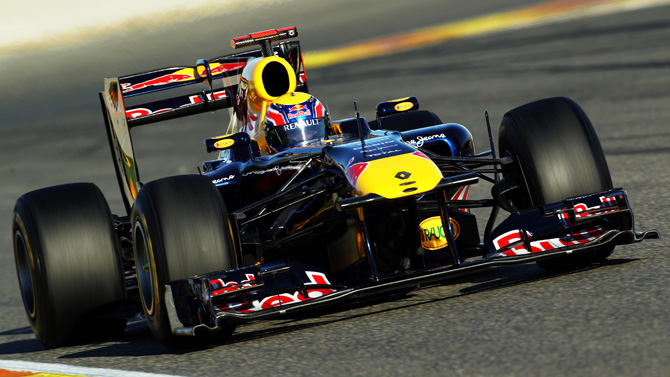
Vettel's helmet, like most Red Bull-backed drivers, is heavily influenced by the energy drink company logo.
New to Vettel's helmet since the start of 2008 has been the incorporation of the red cross of the Kreis Bergstraße coat of arms on the front, just underneath the visor, in honour of the region of his birthplace, Heppenheim.
During pre-season testing for 2010, Vettel debuted a helmet
resembling a Red Bull drink can complete with graphics of a stay-tab
opener on top—which would become a recurring element in his helmets for
this season. During the 2010 season, Vettel has used three main helmet
designs, although he made some minor changes to some in certain races:
besides his standard black helmet, he has used one with the same design
but in chrome colors. For the 2010 Japanese Grand Prix, Vettel had a
special white-red helmet design, with black kanji
and hiragana for "gives you wings". In 2011 he uses his traditional
helmet, with some changes, like the black top and chin area with blue
stylized dots, similar to his black helmet used in 2010.
Comparison to Michael Schumacher
After Vettel's unexpected win in Monza, this led for the media to dub
him the "Baby Schumi", "New Schumacher", but Vettel plays down the
comparison stating he wanted to be the "New Vettel".
He was not just dubbed for his nationality but also because of his
driving style, his concentration and the hands-on role he plays behind
the scenes with his team of engineers. One difference is that Schumacher
does not name his car but Vettel does, Julie (2008), Kate, Kate's Dirty
Sister (2009), Luscious Liz, Randy Mandy (2010) and Kinky Kylie (2011).
Nevertheless, the similarities are marked. Like Schumacher, Vettel
grew up in a small town with an everyday background—Schumacher's father a
bricklayer and Vettel's a carpenter. Both had their first taste of
racing at the Kerpen karting track near Cologne, not far from the
Nürburgring. Vettel began driving in his garden lapping the garden many
times, not even stopping to eat or shower, before he could legally take
to the roads, and says his passion for cars was nurtured by watching
Schumacher compete. He did not know that he would actually get to race
his hero.
Both Schumacher and Vettel impressed in their debut races, both of
which took place in the middle of a Formula One season. Neither would
ever drive for their debut teams again. Instead, both immediately joined
with non-manufacturer teams based upon selling non-automobile related
products. Approximately a year after joining their new teams, as
underdogs they would stun the Formula One world by winning races in cars
few believed capable of winning. In their third full Formula One season
and both driving cars numbered 5, both won their first World Drivers'
Championship, at which point both drivers had 10 Grand Prix wins on
their records. Vettel became the youngest ever driver to win the World
Drivers' Championship, while Schumacher, by a little over a week, only
narrowly missed out on achieving the very same feat. Both drivers won
their non-manufacturer teams' maiden World Drivers' Championship as well
as World Constructors' Championship.
After winning his first championship in 2010, and being hailed as the
'Next Schumacher', Vettel has stated he does not want to aim for
Schumacher's record after learning how hard it was to get one
championship under his belt, though he would like to win more.
Racing record
Career summary
* Season in progress.
Complete Formula 3 Euro Series results
(key) (Races in bold indicate pole position) (Races in italics indicate fastest lap)
Complete Formula Renault 3.5 Series results
(key) (Races in bold indicate pole position) (Races in italics indicate fastest lap)
Complete Formula One results
(key) (Races in bold indicate pole position; Races in italics indicate fastest lap)
* Season in progress.
Formula One records
Vettel holds the following Formula One records:
| Record | Achieved |
|---|
| Youngest driver to drive at a Grand Prix meeting | 2006 Turkish Grand Prix (25 August 2006, aged 19 years, 53 days) |
| Youngest driver to set fastest time in an official Grand Prix session |
| Youngest driver to score points in Formula One | 2007 United States Grand Prix (17 June 2007, aged 19 years, 349 days) |
| Youngest race leader in Formula One, for at least one lap | 2007 Japanese Grand Prix (30 September 2007, aged 20 years, 89 days) |
| Youngest Grand Prix pole position winner | 2008 Italian Grand Prix (13 September 2008, aged 21 years, 72 days) |
| Youngest driver to score a podium position in Formula One | 2008 Italian Grand Prix (14 September 2008, aged 21 years, 73 days) |
| Youngest Grand Prix winner |
| Youngest driver to score a double[] |
| Youngest Formula One World Drivers' Champion | 2010 season (14 November 2010, aged 23 years, 135 days) |
| Youngest World Drivers' Championship runner-up | 2009 season (1 November 2009, aged 22 years, 121 days) |
| Youngest driver to score a triple[] | 2009 British Grand Prix (aged 21 years, 353 days) |