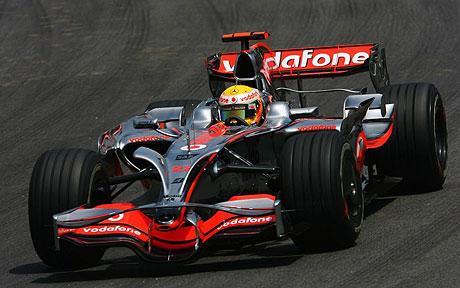
The 2008 Formula One season was the 59th FIAFormula One World Championship season. It began on 16 March and ended on 2 November with eighteen Grand Prix races.
Lewis Hamilton won the driver's title while Scuderia Ferrari Marlboro won the constructors' title[1]. In winning the title, Hamilton became the youngest driver ever to win the title and the first black driver to do so. He was also the first British champion since Damon Hill in 1996[2].
Eleven teams competed in the championship, although Super Aguri
withdrew on 6 May from the 2008 Formula One season due to financial
troubles, completing four races. New technical rules for 2008 included
the banning of traction control after it was re-introduced in 2001. 2008 also introduced two new street circuits. The Valencia Street Circuit and Marina Bay Street Circuit hosted the European GP and the new Singapore GP respectively. The Singapore GP was also the first Formula One event held at night.
This was the last season for the Honda team before they pulled out of F1 later in December due to the global economic crisis. Then, Ross Brawn bought the team and renamed it to Brawn GP in February of 2009 using the Mercedes-Benz engines. This was also the last Formula One season to race with grooved tyres since 1998 before slick tyres returned to Formula One in 2009.
It was the first time in the history of Formula One
that all teams have used the same two drivers throughout the season and
it was the first time that all the race cars were driving without traction control since 1994.
The first multi-team test session started in Jerez on 14 January 2008. Ferrari, McLaren and Toyota all tested their 2008 cars. Williams tested a modified version of the FW29 whilst Renault and Red Bull tested their 2007 entries. Honda, Toro Rosso, Super Aguri and Force India also attended. BMW was not in attendance as they were launching the F1.08[3]. Testing then moved to Valencia
on 22 January. Renault and Williams were the only teams on the track
for the first day of testing. They were both testing their 2008
challengers[4]. They were joined by every other team except Super Aguri for the next three days. 1 February saw testing move to Barcelona. Again, all teams but Super Aguri were in action. The first day of testing saw Kazuki Nakajima crash his FW30[5]. It also saw racist abuse directed at Lewis Hamilton.
Williams withdrew from testing on day three to try to fix the problem
that caused Nakajima's crash. Meanwhile on 4 February, Ferrari and
Toyota moved to Bahrain to continue testing the F2008 and TF108[6].
On 12 February testing returned to Jerez. Red Bull and Williams were the only teams in action on the first day[7].
The second day of testing saw all teams but Ferrari and Toyota (who
were still in Bahrain) attending. After postponing their SA08 launch
and cancelling testing at Valencia, Super Aguri turned up to test their
SA07B interim car for the first time[8].
Testing moved to Barcelona on 19 February. The first day of tests got underway in rain with Williams, Red Bull, Renault and Toyota present. Nico Rosberg topped the time sheets for Williams. BMW Sauber were instead testing on their own in Jerez[9].
Super Aguri did not turn up despite promising a Q&A with the media.
They blamed circumstances beyond their control. On the second day Ferrari turned up and topped the time sheets with Felipe Massa
on another wet track. McLaren joined on the final day and Williams
finished on top with Nakajima. The final multi-team test began on 25
February with every team but Super Aguri attending. Lewis Hamilton
topped the time sheets faster than both Kimi Räikkönen and Michael Schumacher. McLaren continued to outpace Ferrari on day two with both drivers on top and Toyota were fastest with Jarno Trulli on the final day.
Team controversy
There were a total of seven teams signed up to compete in the championship through an agreement with Formula One Management, with the other four major manufacturers in the Grand Prix Manufacturers’ Association (GPMA) having signed a Memorandum of Understanding (MoU) at the 2006 Spanish Grand Prix. All teams in both groups have two spots each on the 2008 grid. One for each of their drivers determined through Qualifying on the Saturday of the race weekend (Sunday hosting the Grand Prix).
On 14 February 2006 the FIA president Max Mosley
announced that all teams interested in competing in the 2008 World
Championship would have a seven-day window during which they would have
to submit an application to compete[10]. All eleven current teams
applied, as well as several others. On April 28, 2006 the FIA announced
that all of the current teams' applications for the 2008 season were
granted, along with a new team Prodrive, fronted by the ex-BAR and -Benetton principal David Richards. There were 21 applications (including the current teams and Prodrive), of which the following were notable: European Minardi F1 Team Ltd, Jordan Grand Prix, Direxiv and Carlin Motorsport.
However despite the Prodrive application being accepted Richards later
announced that the team would not race in 2008 due to a dispute over
the legality of customer cars[11].
On 29 July 2008, the Formula One Teams Association (FOTA) was formed at a meeting of the teams competing in the 2008 championship[14]. This new organization gives a united voice in ongoing discussions regarding the future of Formula One with the FIA and Bernie Ecclestone's Formula One Group. Headed by Ferrari president Luca di Montezemolo[15], the first task of FOTA will be to negotiate the terms of the new Concorde Agreement, the commercial contract which governs the championship, with the FIA and Bernie Ecclestone.
* Team started the season with updated versions of their 2007 car.
Notes
Renault and Honda both started testing their 2008 cars a week before their official launch[25][26].
Although they did not have an official launch, Williams-Toyota gave the FW30 its track debut on 21 January at Valencia during winter testing with a livery of former Formula One drivers on the nose cone who have driven for Williams in the past 30 years.[27] Their season livery was revealed at their photography studio in Oxfordshire on 3 March.
Toro Rosso-Ferrari started the 2008 season with an updated B spec version of their 2007STR2 car stating that their 2008 challenger, the Toro Rosso STR3, was due to make its debut at the fourth or fifth round. The new car made its test debut in the hands of Red Bull junior driver, Brendon Hartley in Italy on 2 April, and was also tested by Sébastien Bourdais. The car made its public debut in Barcelona on April 16[28]. It was later confirmed that the car would first race in Monaco[29].
† Toro Rosso
started 2008 with a modified version of their 2007 car, labelled the
STR2B. The Italian team originally planned to introduce the new STR3
around the fourth or fifth round of the 2008 championship[56], but it finally made its debut in the sixth round, the Monaco Grand Prix.
‡ Super Aguri withdrew on 6 May from the 2008 Formula One season due to financial troubles.
2008 was the first season where no driver was replaced during the
course of the season. Usually some drivers are replaced either for an
injury, a lack of performance or sponsorship related issues. However,
the withdrawal of Super Aguri meant that the line up was still not
identical at every race.
2008 race schedule
The FIA World Council approved the 2008 schedule on 24 October 2007. Singapore was Formula One's first ever night race.[76]
Max Mosley proposed an engine freeze for ten years. Later, all teams agreed to shorten the engine freeze to five years[80].
The first unscheduled engine change of the season for each car did not lead to the usual 10 place grid penalty[81].
Fuel of the cars must have been made up of at least 5.75% biological materials[82].
Gearboxes
to last four races, 5 place grid penalty for a gear box change. If a
driver did not finish a race, he was allowed to change the gearbox for
the next race without receiving a penalty[83].
The use of a spare car was restricted. Each competing team would
not be allowed to have more than two cars available for use at any
time. In this context, a car was considered as such if it was a
partially assembled survival cell, fitted with an engine, any front
suspension, bodywork, radiators, oil tanks or heat exchangers[83].
Tyres
Bridgestone will be the official tyre supplier for the 2008-2010 seasons[85].
Qualifying
The first part of qualifying lengthened to 20 minutes, and final
part of qualifying shortened to 10 minutes. Teams taking part in Q3
would no longer be allowed to add fuel back to the car after qualifying
to eliminate 'fuel-burn' phase.
A minimum lap time for each qualifying session was implemented from
Round 3 in Bahrain to stop cars coasting back to the pits at
dangerously low speeds as seen in Round 2 in Malaysia. Both Lewis
Hamilton and Heikki Kovalainen were demoted five grid places after the
stewards decided that they had impeded Nick Heidfeld and Fernando
Alonso. The minimum lap time was different for each race. For example,
it was 1:39 in Bahrain.
From 8 May 2008, the FIA announced that, following Super Aguri's
departure from Formula One, the qualifying procedures changed. Rather
than six drivers being eliminated at the end of Q1, only the five
lowest-qualified drivers would be eliminated. This increased the
likelihood that one of the midfield contenders would drop out, as only
the top 15 drivers would go through to Q2. The Q2-Q3 transition
remained unchanged[86].
Testing
No competing team was allowed to carry out more than 30,000 km (18,641mi) of testing during the 2008 calendar year[83].
Rumours about the possible sale of the Jordan/Spyker
team had been abundant in the paddock throughout the last few months of
the 2007 season. Only a year after Spyker bought the team from Midland, Indian billionaire Vijay Mallya bought the team for €88 million, several million more than Spyker paid[87]. On 24 October 2007, Mallya was granted permission to change the team's name to Force India.
Force India had a driver announcement ceremony in January 2008 where it
was revealed that Sutil would be second driver partnered by first
driver Giancarlo Fisichella and test driver Vitantonio Liuzzi[70].
On 28 April 2006, rallying and motorsports technology firm Prodrive were officially granted entry to Formula One when the FIA
announced the list of entrants to the 2008 Formula One World
Championship. While a total of 21 teams applied for entry, the FIA had
always maintained that only 12 teams would be granted entry, meaning
only one new team would line up on the grid in 2008. FIA president Max Mosley revealed that Prodrive had found the finances to support their bid. Also, Prodrive's chief executive, David Richards, has experience as a Formula One team principal"[88]. However on 23 November 2007, after lengthy negotiations between FIA president Max Mosley regarding customer cars, Richards announced that Prodrive F1 would not compete in the 2008 Formula One World Championship, as the legal situation left no time for the team to be set up[89].
During the 2008 season on May 6, the Super Aguri team folded and withdrew from Formula One. The team was in dire financial straits at the end of 2007 as the team did not receive a payment on a sponsorship deal[90].
This has led to them becoming the poorest team in Formula One. Super
Aguri rejected a buyout offer in January 2008 from an Indian consortium
led by the CEO of the Spice Group on the condition Indian driver Narain Karthikeyan drove in the line-up, because it meant demoting or cutting one of the team's 2007 drivers[91]. Despite this Super Aguri were unable to sign any contracts until agreements had been reached with their sponsors[92]. Sato and Davidson were confirmed on 10 March[67]. GP2 series driver Luca Filippi was linked to race for the team in 2008, however he instead stayed with the GP2 series for 2008. Super Aguri
announced that a major deal had been made with Magma Group to solve the
team's financial problems, however this fell through, supposedly
because of Magma Group's unwillingness to invest money in a team with
poor results. On 6 May 2008, Super Aguri withdrew from the Formula One
World Championship[93]. It affirmed a prediction at the start of the season by Max Mosley saying the team would not make it to the final race in Brazil[94].
It had been confirmed that Singapore would host a Grand Prix from 2008 for the next five years. It would be a street circuit, with the route designed by KBR. It had been confirmed that the Grand Prix would be a night race[95],
with a start time of 20:00 local time (12:00 GMT) and run in an
anti-clockwise direction to enhance safety by avoiding a bottle neck at
the end of the start finish straight[96]. It had also been revealed that practice sessions and qualifying would take place at night[97].
The European Grand Prix would take place at the Valencia Street Circuit in 2008, changing from the Nürburgring which hosted the event up until 2007. Because both German circuits share the right to host an F1 race, the German Grand Prix took place at Hockenheimring in 2008. It will continue to alternate between these two circuits yearly.
It had been confirmed that the Indianapolis Motor Speedway would not hold a Grand Prix in 2008; however, a possible return to Indianapolis in the future has not been completely ruled out[98].
In the run up to the 2007 French GP it was reported that it would be the last Grand Prix to be held at Magny-Cours[99]. Some alternatives suggested for the French Grand Prix included Paul Ricard or a new circuit near Disneyland Paris or Charles de Gaulle airport. However on 24 July 2007 it was reported that Bernie Ecclestone had "agreed in principle to maintain the race at Magny-Cours in 2008, and even 2009, if there were no other alternatives[100]."
The 2008 season also saw changes to the race start times for China, moved to 15:00 and Australia, moved from its traditional 14:00 slot to 15:30[101].
Other changes
On 7 March, the official Formula One tyre supplier Bridgestone
announced that they would be marking their extreme wet weather tyres
with a white line in the central groove to differentiate it from the
softer wet weather tyre compound. This was so spectators could
differentiate between the tyres in the same way they could with the dry
compounds[102].
† Driver did not finish the Grand Prix, but was classified as they completed over 90% of the race distance.
‡ Super Aguri withdrew from the Formula One world championship on May 6, 2008, with immediate effect[103]. The company went into administration a day later[104].
All broadcasters of Formula One worldwide take what is known as the
world feed for the majority of their race coverage. The host
broadcaster which produces the world feed has access to trackside,
onboard and pitlane cameras. Timing, position and other graphics are
also added to the world feed before it is provided to the broadcasters.
For the 2008 season, Formula One Management, owner of the commercial rights to the sport acted as host broadcaster for 16 of the 18 rounds of the championship[105].
In the Arab world, practice, qualifications and races were broadcast exclusively by Al Jazeera Sports.
In Australia, qualification was aired early in the morning on the race day. The race had recently been shown live on Ten HD. If it started at 10:00pm AEST, it would be shown later on Network Ten, however if at a different time, it would be shown live.
In Brazil, all races and qualifications were broadcast by Rede Globo.
In France, both qualifications and races were broadcast by TF1.
In Greece ALPHA TV broadcast the Grands Prix live.
In India, all races were broadcast by ESPNStar alliance, primarily on Star Sports.
In Malaysia, the race is broadcast live on Pay-TV Astro's ESPNStar Star-Sport's channel. Free TV channel RTM's shows the race delayed, and takes the ITV commentary feed.