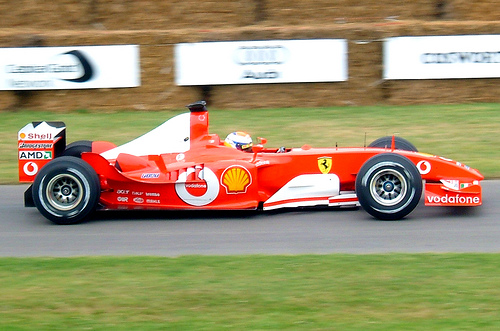
The 2003 Formula One season was the 54th FIAFormula One World Championship season. It commenced on March 9, 2003, and ended on October 12 after sixteen races.
The 2003 season saw the introduction of rules and regulations to
improve F1's excitement and to help the financial difficulties of the
smaller teams. One-lap qualifying was introduced as a way for smaller
teams to get more TV time. Optional Friday testing was introduced to
help reduce testing costs and to give smaller teams a cheaper
alternative to testing in exchange for less testing miles on test days
(which were banned in 2004). Only one type of wet weather tyre was
allowed to be used in wet weather races. The scoring system was changed
to 10, 8, 6, 5, 4, 3, 2, 1 in an attempt to make the constructors' and
drivers' title races closer.
Ferrari'sMichael Schumacher had won the 2002 championship by 67 points from his team-mate Rubens Barrichello.
The 2003 season was much closer: for a great part of the season,
several drivers from several teams had mathematical chances of
competing for the world championship. Eight different drivers won a
Grand Prix, amongst them three first time winners. Kimi Räikkönen, driving for McLaren-Mercedes, and Juan Pablo Montoya,
driving for BMW Williams, both had a chance of claiming the 2003
championship until late in the season, with Räikkönen still
mathematically in contention at the final race, the Japanese Grand
Prix. Räikkönen lost the championship to Schumacher by two points,
although he won only one race to Schumacher's five. Ferrari's defence
of the constructor's title was challenged throughout the year by Williams and McLaren, one of the few seasons where there were three frontrunning teams.
Notable races include the chaotic Brazilian Grand Prix which was hampered by monsoon conditions, and the British Grand Prix where the track was invaded by the now-defrocked priest Neil Horan,
who ran onto the Hangar straight, running towards the 250 km/h train of
cars, wearing a green kilt and waving religious banners.
After failing to complete the 2002 season due to financial difficulties, the Arrows team had their application for admission to the 2003 season rejected by the FIA
prior to the season start date. No reason was publicly given by the
FIA, and Arrows subsequently folded after 25 years in Formula One.
Felipe Massa left his Sauber drive to assume the duties of test
driver for Ferrari. Jenson Button left Renault to take Panis' seat at
BAR. Fernando Alonso moved up from the Renault test driving slot to a
full time drive, replacing Jenson Button. Heinz Harald Frentzen joined
Sauber to take over from Massa. Frentzen had driven for the Arrows team
for part of the 2002 season, but left after the German Grand Prix.
The Arrows team folded several days later without contesting another
Grand Prix. Takuma Sato left the Jordan team to take the place of
several others (Anthony Davidson, Darren Manning, Ryo Fukuda and Patrick Lemarié) as the sole test driver for BAR, being replaced by new driver Ralph Firman.
Team changes
Toyota announced midway through the 2002 season that both drivers
(Mika Salo and Allan McNish) would be replaced. Olivier Panis joined
from BAR and Cristiano da Matta signed from the Newman Haas team in the
CART series. After being replaced at Toyota, Allan McNish signed with
Renault as a test driver. Jaguar replaced both Eddie Irvine and Pedro de la Rosa. Their new drivers were Mark Webber and Antônio Pizzonia. At Minardi,
Webber's vacated seat was filled by Justin Wilson. Alex Yoong's Minardi
contract from 2002 was not renewed and he was replaced in that team by
Jos Verstappen.
Ralph Firman suffered injuries as a result of a crash during practice in Hungary. He was replaced by Zsolt Baumgartner for two races before returning to finish the season in the EJ13.
Having started the season driving for Minardi, Justin Wilson later
joined the Jaguar team and filled in for the under-performing Antônio
Pizzonia for the last 5 races of the season.
Denmark's Nicolas Kiesa took over Wilson's vacated seat in the Minardi.
After a string of disappointing results in 2003, Jacques Villeneuve
was replaced at BAR by test driver Takuma Sato for the Japanese GP.
Villeneuve would later drive for Renault in 2004 as a replacement
driver, and sign a multi-year contract at Sauber for 2005 (though he
was replaced in 2006).
Renault took part in the Friday testing session. People thought it
was not only odd, because not only were they a manufacturer, but also
they would get less testing miles. However, Mike Gascoyne
the technical director for Renault in 2003 said that not only did
Renault save money, Renault also got MORE testing mileage out of their
cars.