The 1989 Formula One season was the 40th FIAFormula One World Championship season. It commenced on March 26, 1989 and ended on November 5 after sixteen races. Alain Prost won his third Drivers' World Championship, and his McLaren team were Constructors' champions.
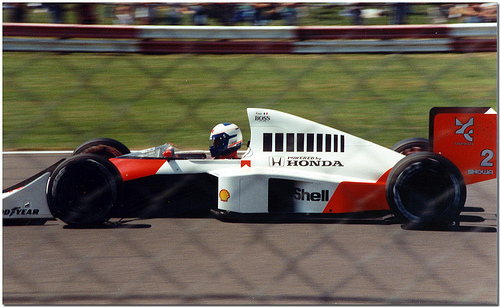
McLaren-Honda won the constructors championship in 1989 with the MP4/5.
Turbocharged engines had been banned at the end of 1988, as they were felt to be making the sport dangerous, not to mention expensive.
In response to the above, a number of new teams were expected to
entered the series, and there would be 39 drivers now competing for 26
spots on the starting grid. A one-hour Pre-Qualifying session was
instituted, in order to render Qualifying itself manageable. Not all
teams were required to Pre-Qualify, and the group of teams required to
do so was revised at the halfway point of the season.
At the start of the season, new (Onyx) or returning (Brabham) teams
had to pre-qualify, along with two Osellas and Zakspeeds and single
EuroBrun. Four teams who had run single car in 1988 had to run one car
in pre-qualifying at the beginning: Dallara, Coloni, Rial and AGS.
At the halfway of the season, Alex Caffi in the 2nd Dallara, both
Brabhams and Volker Weidler in the Rial (although he had never got out
of pre-qualifying in the 1st half of the season and was soon replaced
during the 2nd half of the Season by Pierre-Henri Raphanel) moved up,
whilst Gabriele Tarquini's AGS (although he had scored a point for his
team), both Larrousse Cars and Roberto Moreno's Coloni, which had only
qualify three times and never finished a Grand Prix in the 1st half of
1989 were demoted.
Another new regulation[1] decreed by FISA
was that, in the interest of safety, the driver's feet must be situated
behind the front axle-line. Designers, not thinking of the driver's
comfort, simply designed smaller and more cramped cockpits.The problem
was first highlighted at the first round, the Brazilian Grand Prix, with focus on the Ross Brawn designed Arrows cars. Both drivers, Derek Warwick and Eddie Cheever,
suffered severe cramping and felt the new regulations were in fact
making it more dangerous, with Cheever saying that "if (he) got
sideways ... (he) simply cannot correct with the steering wheel" due to
his lanky frame.[2]
Team and Driver Changes
McLaren-Honda, who had dominated the field in 1988, winning all but one race, stuck to their successful driver lineup of Alain Prost and defending champion Ayrton Senna.
Ferrari were optimistic of being able to challenge for the title. As well as their first 12 cylinder engine since the 1980 season, Ferrari boasted one of the sleekest and highly advanced designs. John Barnard's 640 was innovative, with a distinct nose section unlike any other car. The car also featured a semi-automatic electronic gearbox, the first of its kind. Ferrari also completed the signing of British driver Nigel Mansell to partner Gerhard Berger.
Frenchman Alain Prost (here pictured in 2008) clinched his third drivers' championship after a fierce battle with Ayrton Senna.
The famous old Brabham team had missed 1988 after a change of ownership in late 1987, and the new team, running Judd engines and piloted by Stefano Modena and Martin Brundle debuted in Brazil.
In the event, the only entirely new team for 1989 was Onyx Grand Prix, also running Judd engines, and driven by the experienced Swede Stefan Johansson and Belgian rookie Bertrand Gachot.
Race-by-Race
Race One: Brazil
The climate as the Formula One circus arrived at Jacarepagua was one
of much optimism in what many saw as a new age, with many revelling in
the brutal and much more appealing sounds of the V10 and V12 engines.
Brazil proved to be an excitement filled race, and dramatic too.
Qualifying had a few surprises, with Riccardo Patrese scoring a front row position next to the home favorite, world champion Ayrton Senna. Williams and Renault were both surprised by the position, but both highly pleased with Thierry Boutsen qualifying fourth alongside the high powered Ferrari of Berger.
The race started with a bang, as Senna's hopes at a home grand prix
victory were dashed as he squeezed Berger a little too much. Senna went
on to finish two laps down whilst Berger retired on the spot.
Double world champion Alain Prost's
McLaren had been having problems all weekend, and when his two stop
strategy was ruined by a clutch failure, he knew he had to continue the
race on one set of tires. He finished second. Nigel Mansell secured a
surprising win for the Scuderia, with no problems despite ongoing
gearbox faults all weekend and winter testing. The final step of the
podium was taken by local Maurício Gugelmin.
Race Two: San Marino
At Imola,
"normal service" was resumed. McLaren settled on the front row of the
grid and stayed that way for the race, with Mansell's Ferrari retiring
midway with gearbox issues. Gerhard Berger, despite showing promise by
setting the fastest time in the wet Friday qualifying, suffered a brake
problem and careered off the track at Tamburello
at high speed, forcing the race to be stopped after the third lap.
Berger miraculously survived with just a broken rib, shoulder bone and
burns to his back and hands. He gave a thumbs up and the race was
restarted not too long after. Senna went on to win with Prost second.
Patrese's engine failed and Boutsen was disqualified (but he got his
4th position back in an appeal), so the third place was taken by the Benetton Ford of Alessandro Nannini.
After the Grand Prix, Prost seemed disgruntled and said he wished to
not make a comment on the race, other than that "orders were not
respected". Senna refused to comment on the matter. Before the race at
Monaco, Prost said he wanted "nothing to do with (Senna)" and refused
to speak with him.
Race Three: Monaco
With Berger out, there was 29 cars in qualifying instead of 30,
because Ferrari didn't have a replacement driver. Senna had scored his
third pole of the season, with the number 2 car of Prost again
alongside. March introduced their new 1989 design.[3] Senna went on to win by almost a whole minute over Prost while Stefano Modena secured a valuable third for the rekindled Brabham
team (which effectively was the result that allowed Brabham to avoid
prequalifying in the second half of the season, Modena however failed
to scored any points in any other Grand Prix in 1989), while Michele Alboreto secured his first points since leaving Ferrari for Tyrrell.
Race Four: Mexico
At Mexico,
Gerhard Berger made a return despite continued pain in his fingers.
However, transmission and gearbox problems forced the Ferraris to
retire from point-scoring positions for the third race straight. While
they lamented their results, McLaren and Senna took a third win on the
trot by a differing choice of tires. Prost's choice sent him down the
order to fifth. Patrese was second for Williams, while Alboreto doubled his efforts in Monaco by scoring third. Gabriele Tarquini was able to bring his barely-prequalified AGS home in sixth for a well-celebrated point.
Race Five: United States
The United States Grand Prix
had a new destination, this time in the hot desert of Phoenix, Arizona.
It was a new place, but the same old dirty and dusty street circuits.
Senna made the most of his skill in the wet and scored another pole,
Prost again playing second fiddle by over a second.
However, Senna suffered an electric problem when leading the race,
and Prost took the victory. Williams ended up being the only team to
finish with both cars as the dirty track and unforgiving concrete walls
ended six races, with the heat and dust cutting out many more. One
driver, Nannini, even suffered from driver fatigue
and had to retire, with the Ferrari V12s cutting out from identical
alternator failures. Patrese's second gave him third place in the
championship, while Prost took the lead. An ecstatic Cheever
celebrated his and his team's first podium of the season at his own
home grand prix. The Brabhams, on the other hand, continued their
lacklustre return, both drivers retiring with worn-out brakes.
Race Six: Canada
The Canadian Grand Prix
was run in wet conditions and provided many retirements, but also a new
winner. Senna was comfortably leading with only three laps to go when
engine problems forced him to retire, handing Boutsen his first
victory. Patrese came home second to make it a 1-2 finish for Williams,
the first time a team other than McLaren had achieved this since
Ferrari in Monza the previous year. Andrea de Cesaris picked up third for Dallara.
Race Seven: France
In his home race, Prost took pole and won convincingly, while fellow Frenchman Jean Alesi
made his debut for the Tyrrell team, replacing Alboreto despite his two
strong results. This proved to pay off as Alesi secured a fourth place
finish (having run second at one stage). Nigel Mansell ended Ferrari's
run of retirements with a secure second while Patrese was third. SwedeStefan Johansson also scored the Onyx team's first points. Senna, meanwhile, was forced to retire early on with a differential problem.
The race had to be restarted when, on the first lap, Gugelmin caused
a major first corner accident when he lost control of his March, flew
into the air and landed on Mansell's rear wing. Luckily, no one was
hurt and all drivers managed to take the restart.
Race Eight: Great Britain
The British Grand Prix proved much the same - McLaren front row,
Senna retiring, and Prost winning. Mansell finished second in his home
race to please the British fans, whose Mansellmania coupled with the tifosi made for hysteria. Nannini finished third while both Minardis scored points.
At this, the halfway point of the championship, Prost's lead over
Senna had increased to 20 points. Despite much talk, he downplayed the
thought of a third championship. "I don't want to start talking about
the championship, getting into all that," he said, "but I'm much
happier now, yes. Motivated again. I've had no engine problems since
Mexico, which is nice, and also I'm pleased to see Ferrari getting more
competitive: both Nigel and Gerhard can win races and that can only
help me."[4]
Race Nine: Germany
In Germany, however, Senna's bad luck ended after scoring a treble -
pole, fastest lap and the win. Prost suffered gearbox troubles, while
Berger's pointless season continued with a tire puncture robbing him of
a possible podium. Mansell picked up a third place and mused everyone's
thoughts: "If any of the circuits in the world is ideal for
McLaren-Honda, it's Hockenheim."[5]
Race Ten: Hungary
The dirty Hungaroring
provided an almost gripless practice and qualifying, that eventually
led to the first non-McLaren pole position of the year - Riccardo
Patrese made a Senna-like performance with a 0.31 gap between himself
and Senna himself. Another surprise was the equally impressive Alex Caffi,
who scored third with a time less than a second slower than that of
Patrese - in a car that had been notoriously midfield. The Ferraris,
however, suffered badly. Mansell was over two seconds off Patrese's
time of an impressive 1:19.7, whilst Berger constantly complained of
gear shift troubles - even asking the team to change the gearbox
pre-race, which they didn't.
This eventually cost him a point scoring position, as the gearbox
went on to fail. Countering this was Mansell's impressive 12th-to-first
race, even overtaking Senna in the area he excelled most, lapping back
markers - an impressive move on a track notorious for mediocre and
unpassable races. He went on to compare the race to his win at
Silverstone two years earlier and dedicated it to the late Enzo Ferrari,
a year after the Old Man's death. Caffi's race was the exact
counter-point of Mansell's - despite a strong start he finished a
lonely seventh, earning no points. Senna finished nearly half a minute
behind Mansell in second, while Prost again suffered problems and
finished fourth. Patrese retired from the lead and Boutsen finished
third.
Race Eleven: Belgium
A wet Spa showcased Senna's wet weather skills at their best. 'Magic' (Senna's nickname during the wet[6])
shone that day to give him another win despite engine troubles that
also befell Prost with Mansell in third saying that problems like that
he could certainly use - he finished less than two seconds behind Senna.
Race Twelve: Italy
The Italian Grand Prix sealed the end of two things: Gerhard
Berger's terrible season (he scored a second place on both the grid and
in the race) and Prost's relationship with McLaren. Having become
progressively distanced from the team due to his conflict with Senna,
he announced his switch to Ferrari for 1990, and after inheriting the
race win when Senna retired from the lead late on, he proceeded to give
the trophy he had won to the tifosi. Ron Dennis'
usual composure was shattered and he hurled his trophy at the driver's
feet, storming off. Prost later said it was an unsatisfactory win.
Boutsen inherited third for Williams.
Race Thirteen: Portugal
The thirteenth round at Estoril
turned many frowns and furrowed brows upside down, while it kept the
McLaren men's exactly where they were. Berger won whilst Mansell took
out the world champion in a controversial black flag situation. Prost
scored another podium, with his twelfth point finish, it meant he
started to lose points as only his best eleven finishes counted.
Martini's
Minardi scored a fifth place grid and finish while the struggling Onyx
in the hands of Johansson finshed third (That result was the decision
that Onyx would avoid prequalifying in the 1st Half of 1990). He
marveled at the car's performance on a low-grip track and spoke of
optimism for Spain. The new Williams, however, suffered
near-simultaneous and identical motor blow-outs. Up until then they
looked promising.
Race Fourteen: Spain
In Spain,
Senna, now in a position where he must win all three remaining races,
took a thirty second victory over Berger with another thirty to Prost.
Alesi scored another strong fourth place for the Tyrrell team.
Race Fifteen: Japan
Then the Formula One circus arrived at Suzuka,
Japan for the now infamous penultimate round for the championship.
Prost, after saying he would not leave the door open for his teammate,
who he felt had made far too many risky moves on him.[7]
Senna took pole, but Prost beat him away from the grid and led by
1.4 seconds by the end of the first lap. By lap 15, however, Senna was
all over the back of Prost's McLaren after moving through both Williams
and Benettons. He whittled down Prost's 5 second lead to just under a
second by lap 30, but the latter pulled a few seconds ahead by the 35th
lap. By the end of lap 46, with 7 to go, the gap was just over a
second. Senna, further back then he had been earlier in the race, made
a move on Prost in the chicane before the start-finish straight. True
to his word, Prost closed the gap and the two skidded into the escape
road and both engines stalled.[citation needed] Prost had won the championship and jumped from his car. Senna, however, got a push from the marshals and returned to the track.
He worked his way past both Williams and the Benettons again, to
take a three second victory. However, his altercation with Prost seven
laps earlier meant he had missed the chicane, and not completed the
lap. He was disqualified and Nannini reveled in his first grand prix
victory. The new Williams FW13s finished second and third, putting them
five points ahead of the Ferrari team in the race for second.
McLaren went to appeal the decision. With the matter hanging in the
air, Senna went on record saying it was a plot and conspiracy against
him by FIA and FISA president Jean Marie Balestre
who he said favored Alain Prost. Senna would comment again on the
matter after sealing his 1991 championship, reiterating his belief that
he had been unfairly treated.
Race Sixteen: Australia
The final round at Adelaide saw the race run under heavy rain. Prost
elected to withdraw at the end of the first lap in such torrentially
wet conditions and would score no points. Senna, who still had a slim
chance of winning the championship, pending the appeal, saw no choice
but to race. By lap ten, he had over 30 seconds to the Williams pair
and counting. Instead of relaxing, he continued to push in poor
visibility. On lap 13, he ran into the rear of Brundle's Brabham and
sealed the championship for Prost. The Williams scored a double podium
finish with Boutsen winning, despite being a strong proponent of not
starting in such conditions.
The Australian Grand Prix was overshadowed by the ongoing
controversy surrounding the Japanese race, but once the appeals had
been considered, Prost was crowned the champion for the third time.