The 1988 Formula One season was the 39th FIAFormula One World Championship season. It commenced on April 3, 1988, and ended on November 13
after sixteen races. Two titles were awarded, the Formula One World
Championship for Drivers and the Formula One World Championship for
Constructors.
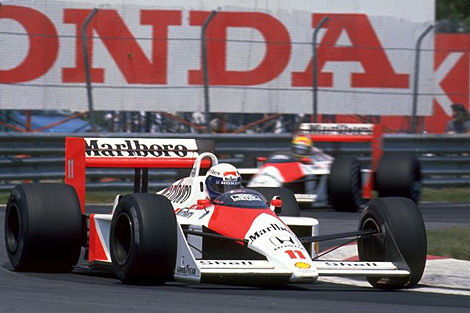
Ayrton Senna won his first world championship in his first season driving for McLaren.
In a year dominated by McLaren, Alain Prost was narrowly beaten by his team-mate.
Gerhard Berger finished third in the Drivers' Championship, and Ferrari were runners-up in the Constructors' Championship, but both were a long way behind McLaren and its drivers.
The pre-season was a very contentious time, with many theories of
the championship flying around. Would the Honda engines prove
successful with McLaren? Would Ferrari be able to continue the trend set by the last two rounds of 1987 where Gerhard Berger took successive victories? Would Williams be able to continue their success without Honda and Nelson Piquet? Could World Champion Piquet succeed in defending his title with the Honda powered Lotus?
The Jim Clark and Colin Chapman cups had been withdrawn as the "atmospheric", naturally aspirated
engines were making a return as the sole engine for 1989, with severe
restrictions on turbos for this season. Many teams took the gamble of
using Judd or Cosworth
V8 engines, to get an extra year in to get used to the new regulations,
whilst other teams like Ferrari and McLaren decided to make the most of
their turbo experience and made one last turbo car to hopefully bring
the most of the cars despite the regulations.
For the first race of the season in Brazil, with Ferrari being the
only completely stable option, many agreed that Gerhard Berger would be
in serious contention, and this was supported in his second place
behind Alain Prost's McLaren as well as securing the fastest lap for the Scuderia. Remarkable, also, was Nigel Mansell's
recovery from his accident in Japan to score a front row position for
his non-turbo Judd-powered Williams on his first race back. Ayrton
Senna suffered from a failure at the race's beginning, eventually being
disqualified after switching to a second car. At the time he had risen
up to second place after starting from the pits.
At Imola, however, it was plain to see what all the teams had feared. Gordon Murray's MP4/4, combined with the championship winning Honda Turbo, made a mockery of the rest of the grid. Even the Lotus-Hondas of Piquet and Nakajima
were left a lap behind race winner Senna, with team-mate Prost less
than five seconds behind him. At the front of the grid, things were as
tight as ever, however for everyone else it had become a race for third.
Despite what many expected, the championship would hardly be
considered boring with the McLaren onslaught peaking with the drivers
fighting in several feuds. At Monaco,
after Alain Prost set the fastest lap, Ayrton refused to accept that
his team-mate could be driving faster than he was, especially after
Senna out qualified Prost by over a second. Senna pushed and after
scoring the fastest lap, he had a lapse in concentration and hit the
wall. Berger picked up second place behind Prost.
In Mexico, it was nearly a repeat of San Marino: McLaren 1-2, with
this time only one driver on the lead lap. Gerhard Berger had picked up
his third podium in four races, giving him the edge on Piquet and Alboreto for the title of "Best of the Rest" - The race for third.
Canada again proved a repeat of the McLaren onslaught, this time Boutsen's Benetton
being the only other car on the lead lap, and 50 seconds behind. This
was repeated in Detroit, however this time Boutsen failed to stay on
the lead lap as Senna took his second victory in a row, making it six
out of six for McLaren and Honda.
The following race at Paul Ricard
saw another 1-2 for McLaren, this time with Prost at the helm for his
home Grand Prix, followed by the Ferraris of Alboreto and Berger, with
only the former on the lead lap. Piquet raced a brilliant race, despite
lacking second gear, to come through for a fifth place.
At the wet British Grand Prix at Silverstone, Nigel Mansell
surprised all by scoring a second place for an atmos car for his first
finish of the season after seven races of DNFs, a result which
definitely pleased the hordes of British fans who were still gripped in
Mansell-mania despite the driver's (or rather, the car's) lack lustre
performance through the year. The podium was rounded off by Nannini,
proving that Silverstone's long straights, although showcasing the high
speed of the turbos, was not a good race for the to-be-banned cars,
with the efficiency of the atmos cars proving a much better deal,
albeit Senna still dominating in his McLaren, proving once again his
skill as a wet weather driver.
Germany proved a return to the year's trend, with again long straights of Hockenheim
showcasing the brute strength of the turbos, with the only atmos car on
the lead lap behind both McLaren and Ferraris respectively being Capelli'sMarch.
Senna took the win to Prost, with Berger taking the bottom step of the
rostrum. At the following grand prix at Hungary, Senna secured his 24th
pole position, securing the third highest total after legendary
champions Jim Clark and Fangio,
backing his qualifying effort up with a victory, less than a second in
front of team-mate Prost. This was Senna's sixth win of the season, and
third on the trot, with Prost on just four wins.
The 1988 Belgian Grand Prix
showed Prost one thing: to not change his set-up at the last minute.
All through the year, Prost's better feel at setting up a car was not
only noticed by his team-mate, but mimicked. Senna had used Prost's
set-ups for every race thus far, and the race at Spa was no different.
This annoyed Prost, and he changed his aero-settings at the last
minute, hoping to give himself an edge over the pole-sitting Senna. At
the start, Prost took the lead after Senna suffered wheel spin but was
caught and passed half way around the track.
Senna went on to secure the victory to Prost, a distant second.
Third and fourth was filled by the two Benettons, however their
finishes were struck from the results long after the race had ended,
for using illegal fuel, giving Capelli his first podium of the year.
The 1-2 for McLaren signified the end of any statistical hope of
Ferrari catching them in constructors championship, securing McLaren
one of the earliest recorded constructors victories.
Before the Italian Grand Prix,
Prost was quoted as saying that, as it was very possible that McLaren
would take out a perfect sixteen out of sixteen victories, the winner
would be determined between which McLaren driver would take the most
wins, and on the change they both took eight, it would be determined on
their second places, which at the time Prost had more of despite having
fewer wins. This meant Prost could only let Senna win one more time.
Monza, being another high speed circuit, would prove to be another
McLaren dominated race, with both sitting on the front row, again with
both Ferraris behind. The race fell into regular routine as Senna lead
from the start and Prost close behind. However, on lap 35 of 51,
Prost's championship hopes seemed to evaporate in a cloud of smoke,
leaking from his engine. The tifosi
cheered as their drivers were shifted to second and third, and Honda
were livid in their engine expiring on a track that was being dominated
by the turbo cars.
Senna looked set to secure another victory, and albeit seal his championship hopes, when lapping Schlesser,
filling in for the still ill Mansell, decided it was wise to do so on
one of the track's corners, instead of waiting for the long straight
that would follow. Senna accidentally hit Schlesser and was livid,
whilst the tifosi erupted; Gerhard Berger and Michele Alboreto sat
first and second, where they remained at the finish. The victory was
made poignant by the fact that it was the first race since Enzo Ferrari's
death. Both drivers and team dedicated the victory to him. This race
would prove to be the only chink in McLaren's perfect year and their
only double retirement.
The following grand prix at Portugal proved to be an exciting
affair, for all but Ayrton Senna who suffered race long with fuel
troubles. He ended sixth while Prost kept his championship hopes alive
to secure his fifth race of the year. Then at Spain, he secured his
sixth, again in an attempt to delay an almost inevitable eighth race
for Senna - a race that would secure his first of three championships.
Senna suffered from similar problems and was lucky to secure fourth
whilst Mansell doubled his British Grand Prix efforts and scored
another six points.
The penultimate round in Japan was, once again, where the title was
decided. This time it was the end of the weekend, and not the
beginning. Prost made a superb start to the lead, whilst Senna stalled,
lucky in the fact that Suzuka had a sloping grid, helping to start his
car. Senna knew he had nothing to lose and everything to gain in this
race, and knew he could seal the championship here. By the end of the
lap he had already made up six positions, and by the fourth lap he was
sitting in fourth position. The top six cars were all sitting very
close and when the rain started to fall, so did Prost. Capelli took
this chance to become the first naturally aspirated car to lead a Grand
Prix in over 4 years, thrilling the March team. Unfortunately, this was
not to last as his electronics would eventually fail.
By then, Senna was hot on the tail of Prost. Prost hated the wet, as
much as he hated to lose, and his failing gearbox only added to the
Brazilian's chances. When the pair came round to lap some back-markers,
as Prost was caught up with de Cesaris,
Ayrton went past to take the lead, and set three consecutive fastest
laps and setting a new lap record. As he was now out on a wet track
with dry tires, as many other drivers were, he signaled to stop the
race. However, the race ran its full distance and Honda were reveling
in their 1-2 finish, whilst Prost was bitter. He would go on to win in
Adelaide, and score eleven more points in total than Senna, but only
the eleven highest scores counted, with Senna's eight wins and three
seconds giving him a total of 90 points to Prost's 87. He went on to be
a proponent of the 90's scoring system - all results counting to the
final results with the winner scoring 10, not 9, points.
Drivers and constructors
The following drivers and constructors competed in the 1988 season
Drivers Championship points were awarded on a 9-6-4-3-2-1 basis to the first six finishers in each race .
Only best 11 results counted toward the championship .
Prost scored 105 points during the year, but only 87 points were
counted toward the championship. Senna scored 94 points, with 90 points
counted toward the championship. Thus, Senna became the World Champion,
although he did not score most points over the course of the year.