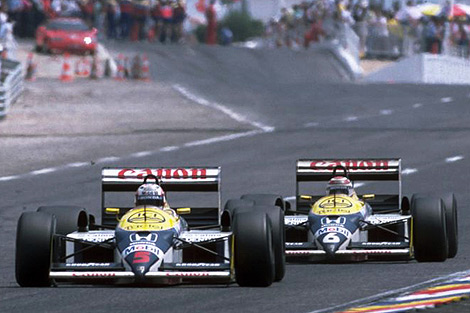
The 1985 Formula One season was the 36th FIAFormula One World Championship season. It commenced on April 7, 1985, and ended on November 3 after sixteen races.
The 1985 formula one season saw continued success for the
McLaren-TAG team. After missing out on the championship by just half a
point the previous year, Alain Prost
would ultimately secure his first of four titles by a 23-point margin.
The Formula One writer Koen Vergeer remarks that "it was about time,
everyone knew he was the best",[citation needed] reflecting a general feeling that Prost had been unlucky to finish runner-up twice, to Nelson Piquet and Niki Lauda.
The reigning champion Lauda competed in his final season of Formula
One but was unable to match Prost for results, winning just once at Zandvoort despite being close to his team-mate in terms of pace. For much of the season the points table was headed by Ferrari's Michele Alboreto,
who enjoyed his best season in F1. He won the Canadian and German
Grands Prix, and was on the podium eight times. Ferrari's results faded
badly in the second half of the season as other emerging drivers took
the fight to Prost.
Among these were Ayrton Senna and Nigel Mansell, both of whom scored their first victories in 1985. Lotus team manager Peter Warr
had replaced Mansell with Senna going into the season, a decision which
initially seemed justified when Senna took a superb win in the wet at
Estoril. However Mansell fought back with Williams, and chalked up two
victories near the season's end, including his famous breakthrough win
at Brands Hatch. Mansell would go on to mount a serious title challenge
in 1986. Perhaps the fastest combination of the year was Keke Rosberg in the other Williams, who used the powerful Honda engine to set a new lap record around Silverstone
in qualifying for the British Grand Prix - becoming the first man to
lap at an average speed of over 160 mph (257 km/h). He finished third
in the standings after wins on the street circuits of Detroit and
Adelaide, but lacked the reliability to overcome Prost.
1.5-litre turbo engines had become universal by 1985, heralding the extinction of the Ford Cosworth DFV.
Between 1985 and 1986 Formula One engines would achieve the highest
levels of power ever seen in the sport, before serious restrictions and
their 'phasing out' began in 1987. The power output of the engines was
controlled in racing conditions by means of a strict fuel limit;
however in qualifying trim teams were commonly able to increase the
boost of their engines for optimum power. This fuel economy was key to
successful race strategy in 1985; Mansell recalls the added interest of
planning his fuel use in his autobiography. It also proved costly for
Ayrton Senna, who lost victory just four laps from home at Imola when
he ran out of fuel. After Prost was disqualified for an underweight
McLaren, victory fell to the other Lotus of Elio de Angelis.
1985 also saw a welcome return to the calendar of the Spa-Francorchamps
circuit in Belgium. Although shortened from its dangerous 1960s form,
it remained a challenge for the drivers. It also caused one of the few
cancellations of Grands Prix in the sport's history, when the new
all-weather track surface broke up badly during practice. Extensive
repairs were needed and the race was rescheduled for later in the year;
Senna was the winner, with Prost finishing on the podium again to take
a big step towards his first championship.
The Dutch Grand Prix was the last Grand Prix for Stefan Bellof, who died in the World Sports Car Championship race at Spa Francorchamps in the famous Eau Rouge corner. He was the reigning world champion in this series, but decided against running for the Porsche
factory team in 1985, to concentrate on formula 1, but was still
driving in various WSC races for the private Brun team. Until his death
Stefan Bellof
was one of the rising stars in racing, being rumored to having an offer
to drive for Ferrari in 1986. The summer of 1985 was remembered as the
sadest weeks for German racing, as both German formula one drivers, Manfred Winkelhock and Stefan Bellof died within three weeks in WSC races.